Performance Art: Disobedience II (2025) Proposal
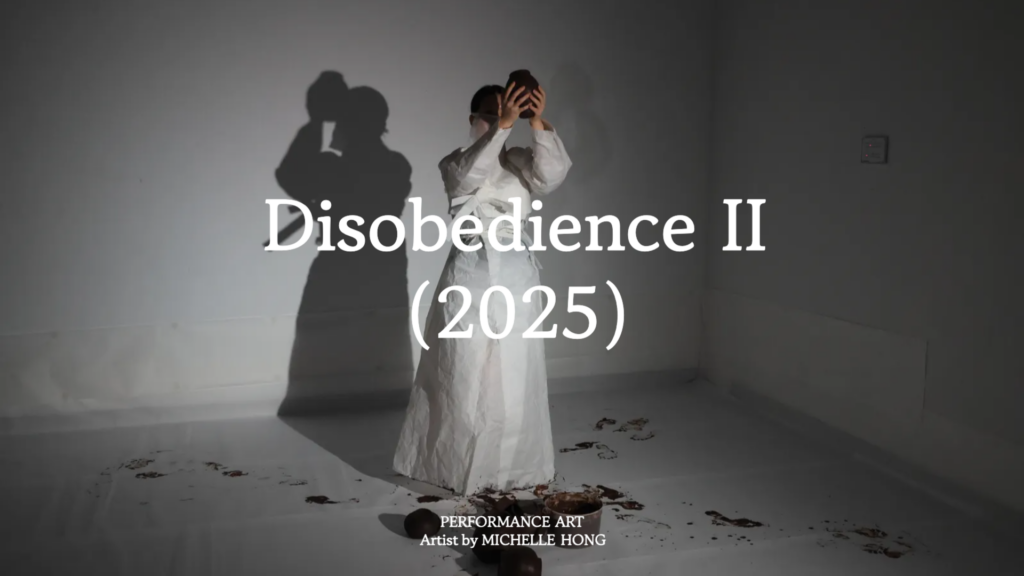
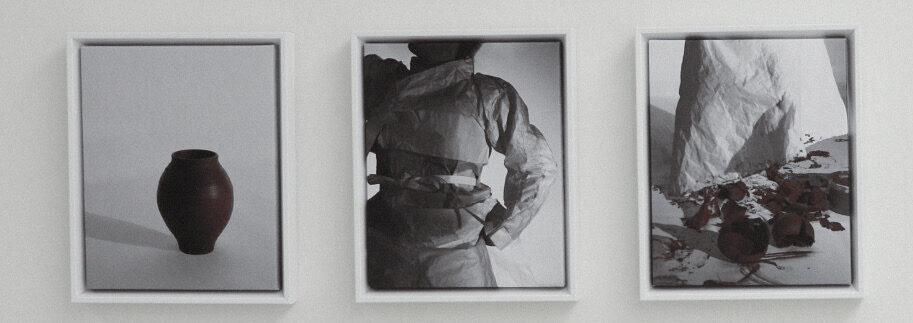
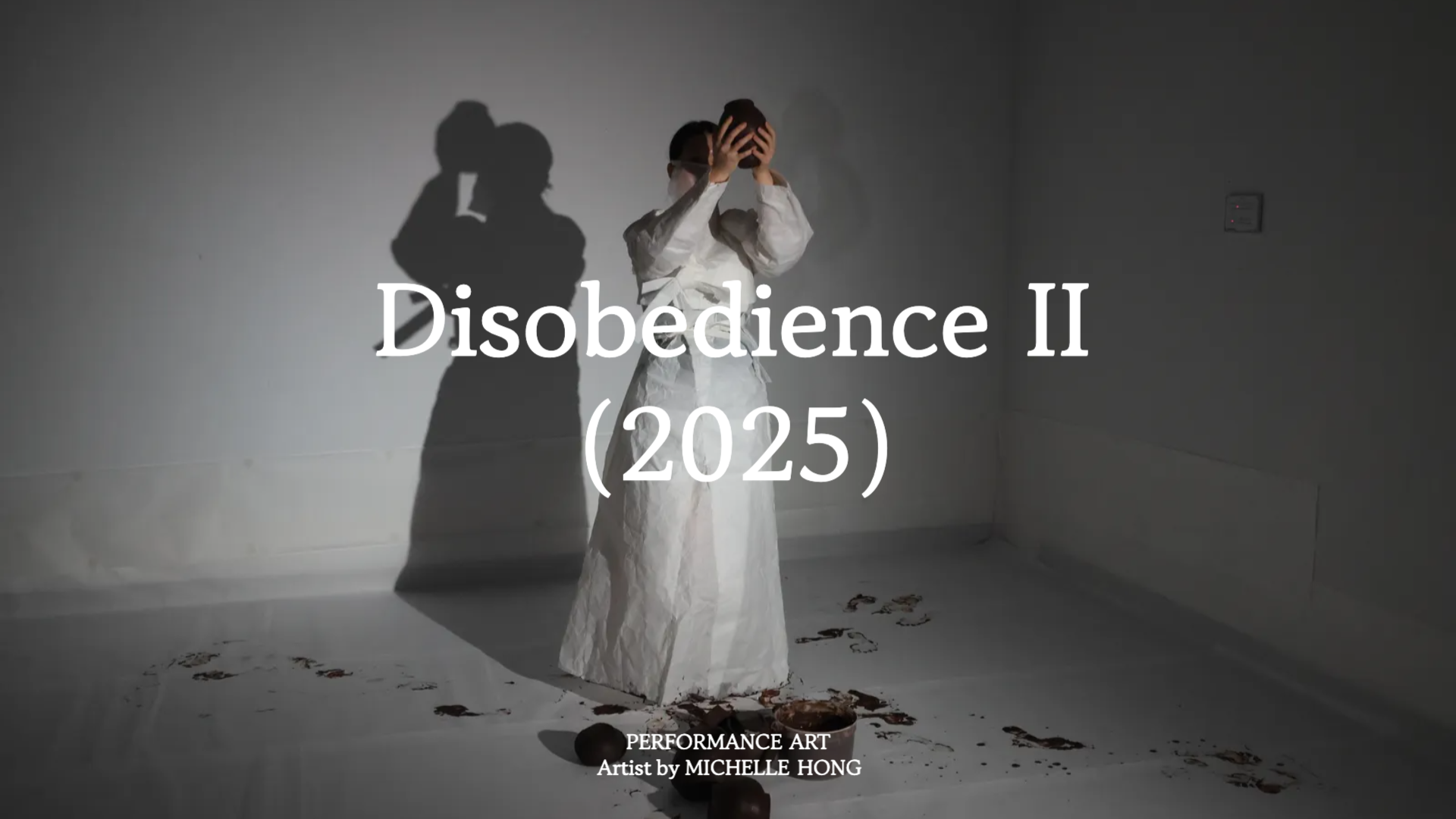
“Disobedience II (2025)” is a performance-based photography project that explores “Han (한)”—a deep-seated resentment within Korean cultural identity—through the performance of unfired ceramic pots and digital photographic representation. ”Han (한)“ embodies suppressed anger, particularly among women, as a result of inescapable circumstances such as the Korean War and Japanese colonization. Inspired by the Korean proverb, “A woman carrying resentment can have frost even in midsummer,” my body expresses the duality of an outwardly calm and composed appearance while harboring deep-seated anger and resentment.
In my project, I photograph myself wearing white traditional paper Hanbok, putting plastic clay on thin Mulberry paper and stepping on clay. I was born and raised in South Korea until I was 16, when my family abruptly immigrated to Canada. Without fluency in English, this unexpected move caused immense trauma. I found myself unwilling to engage with my new environment, unable to adapt, and burdened by the grief of displacement. The language barrier and experiences of bullying deepened my feelings of weakness and depression. However, in my journey towards resilience, I discovered that art could help me confront my turbulent memories. Disobedience II (2025) explores the symbolic elements of the white traditional clothing Hanbok, Korean jars, and the expressive body movements associated with Han (한) that represent sorrow from oppression within Korean identity.
In Disobedience II (2025), I connect my personal exploration of cultural identity with the metaphorical significance of Korean traditional clothing, Hanbok, body gestures, and ground clay. I regard the Korean traditional white Hanbok (한복) as a symbol of peace (Lee 289). Beyond representing my cultural identity, the Hanbok also embodies Korean ethnonationalism. The white Hanbok signifies purity and aesthetic value, with its elegant lines hinting at a compliant image of women. During the post-war recovery and decolonization period, the white Hanbok also came to symbolize resistance and defiance (Lee 288). It represented the unity and assertiveness of the Korean people, becoming a symbol of integrity and the national liberation movement. These symbols inspire an exploration of deprivation, where the white Hanbok evokes a sense of restrained desire. To make a white Hanbok, I choose thin Mulberry paper that signifies Korean traditional material. The choice of thin Mulberry paper ties into the traditional Korean calligraphy culture, “Seoye (서예).” This highly absorbent paper visually conveys the depth of Korean thought, symbolizing identity through its delicate materiality.
In Disobedience II (2025), clay plays a crucial role in exploring inner sensibilities. The tactile interaction between my hands, feet, and the pliable clay fosters a therapeutic dialogue that aids in emotional regulation. As Che states, “Clay has a persistent, hidden memory. When reshaped, it remembers its past” (19). Working with clay allows unconscious emotions to surface, translating them into a visible form. The characteristics of clay and the state of my mind resemble the traces that accumulate over time.
The process of wheel-throwing a jar is deeply connected to Korean history, particularly the “Moon jar,” an iconic object from the late 18th-century Joseon Dynasty. The Moon jar’s asymmetric beauty represents a cultural form that I explore through wheel-throwing, expressing Korean identity through the medium of clay. This practice evokes a sense of biological stability and euphoria, enriching my emotional exploration.
The project also delves into the concept of Han (한)—a profound feeling of stifled ambitions and deep-seated resentment. Han arises from historical tragedies such as foreign invasions, colonization, civil war, and internal divisions (Gunnars 450-451). In Korea, many women historically sacrificed their well-being for familial survival. The Hanbok and famine makeup symbolize their grief. The expressive gestures of throwing and stepping on clay pots embody the anger inherent in “Han (한)”. I choose the “Moon Jar” and mud clay simultaneously in my performance to trace the body’s gestures, specifically the movements of the feet, as they interact with “Han”, reflecting the trauma and resistance shaped by the Korean War and Japanese colonization. Through these physical gestures, I confront my concealed trauma from immigration in Canada, affirming my identity through bodily expression.
Recognizing cultural conditioning through identity art is a significant journey, marking the early steps of my artistic career post-graduation and beyond. Disobedience II (2025) engages with latent emotions and possibilities, serving as an experimental phase in my art practice. I hope this uninhibited expression of Korean identity will open doors to further artistic discovery and growth.
Bibliography
ArtsKoreaTV. “한 (Han).” YouTube, youtu.be/kellIInqzqo?si=2D2dCR32G77rrTkg. Accessed 4 Feb. 2025.
Che, Xinwei. “Inhabiting Time: Holding Material Time through Performance.” Google Drive, Google, Accessed 28 Jan. 2025.
Che, Xinwei. “Maintenance in progress” 2021,
www.xinwei-c.com/#/maintenance-in-progress/. Accessed 14 Jan. 2025.
Gunnars, Kristjana. “The Discourse of Korean Han: Background and Historical Landscape.”
Korean Studies, vol. 48, Jan. 2024, pp. 449–76. EBSCOhost, https://doi.org/10.1353/ks.2024.a931009.
Lee, Yeseung. “The White-Clad People: The White Hanbok and Korean Nationalism.”
Cultural Dynamics, vol. 34, no. 4, Nov. 2022, pp. 271–96. EBSCOhost, https://doi.org/10.1177/09213740221117811.
“Moon Jar: Korea: Joseon Dynasty (1392–1910).” The Metropolitan Museum of Art,
www.metmuseum.org/art/collection/search/45432#:~:text=Moon%20jar-,Korea,example%20has%20a%20 unique%20 shape. Accessed 21 Jan. 2025.
Nanibush, Wanda. “Clay on Stone: Rebecca Belmore.” Rebecca Belmore,
www.rebeccabelmore.com/clay-on-stone/. Accessed 14 Jan. 2025.
Surl, Hayun. “Onggi through the Ages.” Default,
ceramicartsnetwork.org/ceramics-monthly/ceramics-monthly-article/onggi-through-the-ages#. Accessed 21 Jan. 2025.
Explore Michelle’s previous work “Disobedience (2024)”